For the last decade, “go solar” has been the defining message for clean energy. Panels are cheap, getting cheaper, and the carbon math is unambiguous. What is rarely said in the same breath is the inconvenient truth: Going solar, today, means going Chinese.
China holds roughly 80% of the world’s solar manufacturing capacity end-to-end. Upstream, the picture is starker: 83% of polysilicon and 97% of wafer production, with Xinjiang alone accounting for ~40% of the world’s polysilicon. Every conventional panel begins with a Chinese product.
The energy transition is sold as liberation from the petrostates. In practice, it is closer to a swap. Russian gas and Hormuz oil for Xinjiang silicon.
The closure of the Strait of Hormuz this spring has made that swap look much worse. The disruption of ~20% of global oil flow earned the IEA’s label as the “greatest global energy security challenge in history”, and the lesson it has driven home in every importer’s foreign ministry is the obvious one: concentrating your energy supply through a chokepoint in an unstable or unreliable region is the kind of strategic error you should only make once.
For Japan, the situation is even worse. 95% of crude imports come from the Middle East, 80% transit Hormuz, and energy self-sufficiency sits at just 13%. A single waterway 8,000 km away can throttle the fourth-largest economy on earth.
The whole point of the energy transition is to escape that kind of exposure, not to relocate it. Trading Hormuz oil for Xinjiang silicon is not solving the problem. It is choosing a different chokepoint.
Japan used to dominate solar. In 2004, Japan made more than half of the world’s solar panels. Sharp, Sanyo, Kyocera, and Panasonic defined the industry. Between 1985 and 2007, Japanese researchers filed more than twice as many solar patents as the US and Europe combined. Then subsidies were pulled, China’s state-backed scale-up arrived, and within fifteen years Japan’s mass producers had exited the market. The first solar war was lost.
But the second one is quietly commencing. There is another way to make a solar cell, and with this one, Japan has the structural advantages.
A Different Kind Of Solar
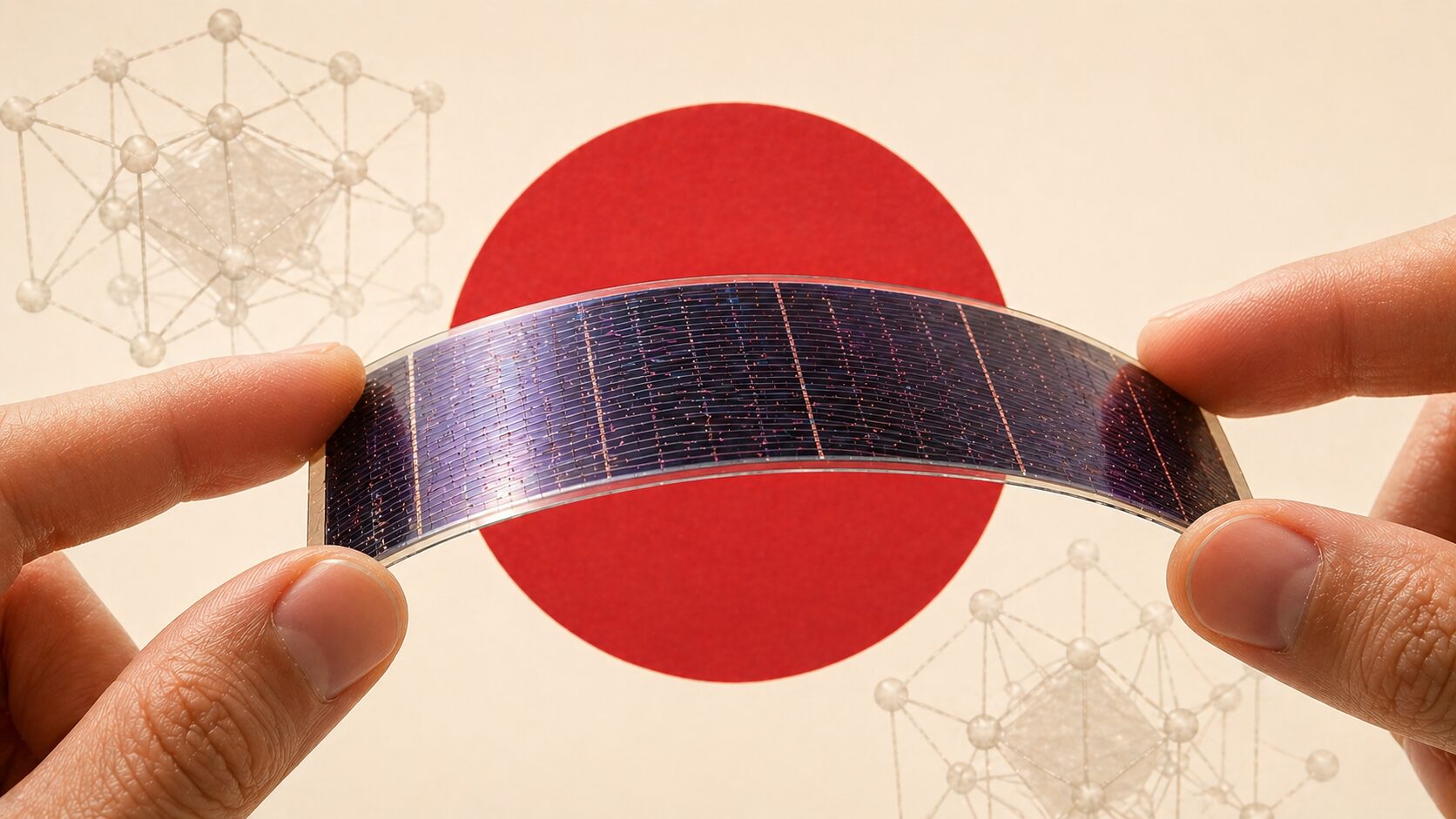
Perovskites are crystalline materials with two useful properties. The first is that you can apply them as a coating, like ink, onto film, glass, or curved surfaces, using roll-to-roll manufacturing rather than the fab-like process silicon requires. The second is that they are now technically competitive: certified efficiency, the light energy can actually be converted into electricity for a single-junction perovskite cell hits 27.3%, and perovskite-silicon tandems have reached 35.0%, comfortably above commercial silicon.
Solar can now go where panels never could. The exterior wall of a Shibuya office tower. The curved roof of a bus terminal. A gymnasium that cannot bear the weight of glass modules. Perovskite films are around one-tenth the weight of conventional panels.
This is particularly useful for Japan. Japan is mountainous, dense, and short on the open land that hosts utility-scale solar. What it has in abundance is vertical surfaces; lots of buildings. The geography that made silicon a poor fit makes perovskite a near-perfect one.
Japan Owns Upstream Supply Chain
Perovskite cells are built around halide compounds, typically methylammonium lead iodide. Iodine is the critical input.
Today, Chile produces ~59% of global iodine (~26,000 tonnes in 2024) from its Atacama brines. Japan is second at ~30%, drawn from underground brines in Chiba.
However, production is not where the leverage lives. Look at global reserves.

Japan sits on 79% of the world’s known iodine reserves while producing only 30% of supply. Almost all those deposits sit under one archipelago. Japan has virtually no natural resources, but it turns out that iodine is one of the few it does have in spades. The geologic deck has dealt Japan a royal flush this time.
Perovskite vs. Silicon
A common skeptic view is that perovskite modules don’t beat Chinese silicon panels on cost per watt. True, for now, but that’s beside the point.
If a Shibuya building owner is choosing between perovskite film and a Chinese silicon panel for the same wall, perovskite probably loses. But that is not the choice. The wall is currently generating zero kilowatt-hours. You cannot put a 20-kilogram glass panel on it. The real comparison is perovskite vs. nothing. Against nothing, the bar is grid electricity prices.
METI’s cost trajectory is JPY 20/kWh today, JPY 14/kWh by 2030, and JPY 10–14/kWh by 2040. Japanese commercial grid electricity already runs ¥18–25/kWh. The economics already work for some early use cases, and they are getting better.
The initial addressable market is not “global solar.” It is the enormous footprint of vertical and curved surfaces that conventional silicon can never reach. China does not currently serve that market. Japan is uniquely positioned to define it.
The Japanese Players Working On This
Several Japanese companies are pushing perovskite into commercial reality.
Sekisui Chemical leads on the film-type cell. It has already mounted perovskite on its Osaka headquarters, the Tokyo International Cruise Terminal, and the curved roof of the Expo 2025 Osaka-Kansai bus terminal, the world’s largest installation of its kind. It has committed JPY 310 billion (~$2 billion) to scale to 1 GW of annual production by 2030.
Panasonic is taking the glass route, targeting building-integrated photovoltaics: windows and façades that double as power generators. Toshiba, Ricoh, and Kyoto-based startup EneCoat are advancing alongside under METI’s ¥24.6 billion ($167M) subsidy program, with a national target of 20 GW of domestic capacity by 2040.
China Sees It Too
Chinese silicon makers are racing into perovskite themselves, with GCL Technology’s $700 million Kunshan factory, UtmoLight’s first gigawatt-level production line, and over 60 Chinese companies now producing modules. When the world’s biggest silicon manufacturers bet at this scale on a new chemistry, there must be something to this perovskite thing.
But this time, the game is different. China dominated silicon because polysilicon refining could be scaled with capital, energy, and policy. Iodine cannot. Reserves are inherited, not built; they sit where the geology put them, and the geology put 79% of them under Japan. A Chinese gigawatt-scale perovskite line still has to buy iodine somewhere.
Last time, Japan had the technology lead and lost the cost war. This time, Japan is upstream.
Japan Is Back
Japan invented modern silicon photovoltaics, lost the industry to a competitor that subsidized its way to dominance, and is now staring at a second chance. This time the upstream resource is under Japanese soil. This time the form factor maps to Japan’s geography, and this time, the policy machine is engaged early.
It is not a guaranteed comeback. The technical problems have to be solved, and Japan still needs to convert its upstream advantage into manufacturing before Chinese capital outspends it on the cost curve.
But Japan has an overwhelming advantage. The country that holds 79% of the world’s iodine, the country whose buildings are crying out for vertical solar, and the country that filed half the world’s solar patents two decades ago are the same country.
The first solar revolution was about silicon, and Japan lost it. The second is about chemistry that gets coated rather than sliced, on surfaces that no panel could ever reach, using an element pulled from the brine under Chiba.
Japan is back, and the dealer has dealt it an exceptional hand. It’s time to place bets.