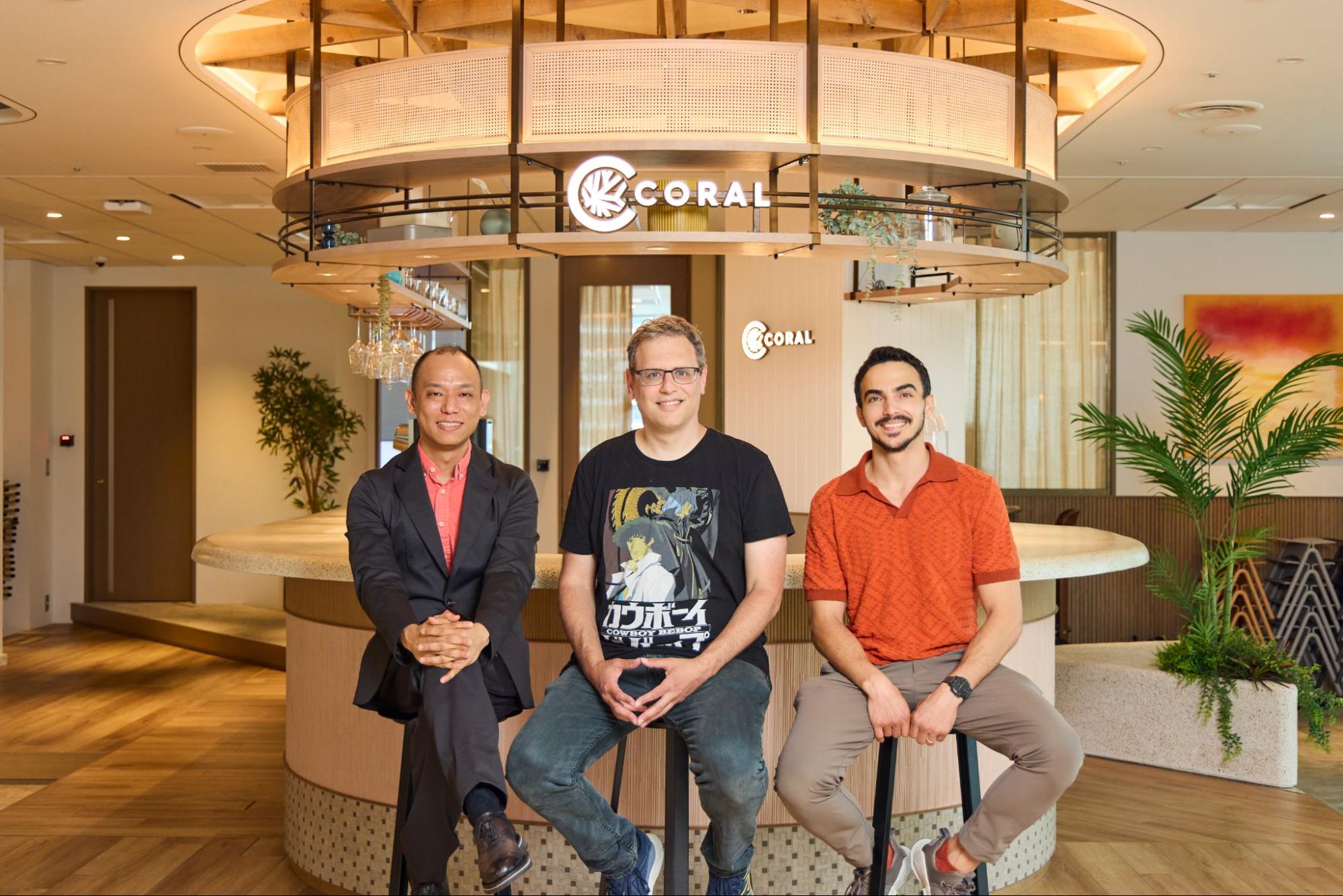
On May 13, 2026, Anduril announced its $5 billion Series H at a $61 billion valuation, co-led by Andreessen Horowitz and Thrive Capital. Coral Capital participated in the round.
It is one of the largest private financings in defense technology to date, and in our view, one of the most strategically important moments in the eighty-year arc of the US-Japan alliance.
The Mission, and Why Anduril Belongs in It
Coral’s mission is to partner with the companies defining Japan’s next century. At first glance, Anduril may not seem to apply. It is a Costa Mesa-based defense technology firm founded by Palmer Luckey, Brian Schimpf, and Trae Stephens. It builds autonomous fighters, undersea drones, counter-UAS systems, and an AI command-and-control platform called Lattice. None of that seems Japanese.
But look closer at what Anduril is actually made of.
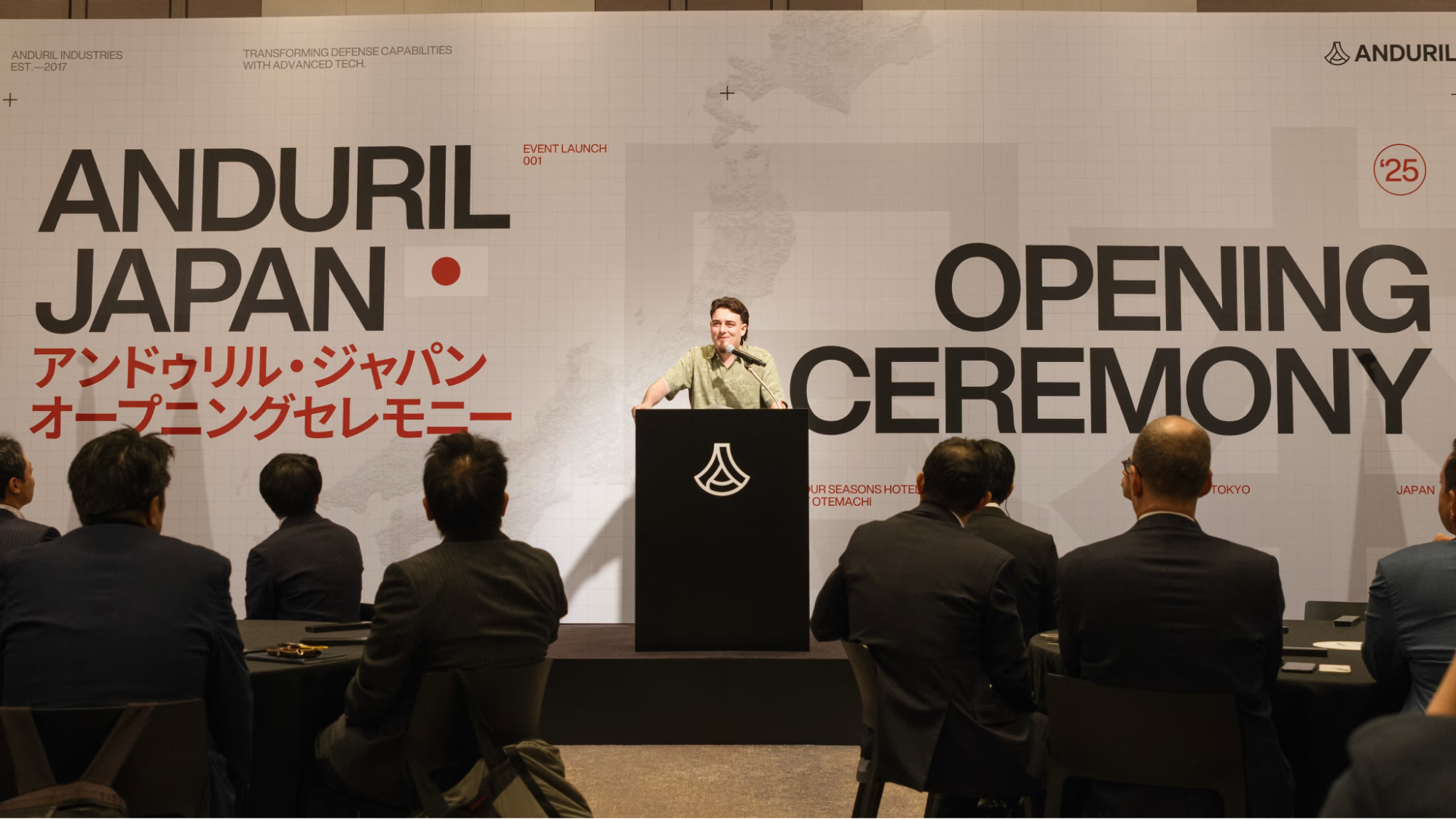
In December 2025, we attended Anduril’s Japan launch event in Tokyo. Dozens of Japanese companies were in the room, and many were already Anduril suppliers. They were not hoping to break into the defense supply chain. They were already in the defense supply chain, and had been for years, without most people outside this world realizing it.
In fact, at this event, Palmer unveiled the Kizuna drone, a product built entirely from Japanese components. Japanese manufacturing throughout. American in brand, architecture and software, Japanese in every physical component. Palmer put it plainly: “Japan is one of the only countries that can do it all on their own.”
We wrote about this pattern earlier in the year. It extends well beyond Kizuna. If you are building hardware, drones, satellites, or autonomous systems at scale, your supply chain likely runs through Japan. Sony alone is approaching 50% of the global market for CMOS image sensors, the cameras inside virtually every modern drone, smartphone, and ADAS system. Toray Industries supplies the carbon fiber used in the primary structures of the Boeing 787 and Airbus A350, and Japanese firms together hold an estimated 50-60% of the global supply of aerospace-grade carbon fiber.
Japan has already played an essential role in building Anduril, but this next chapter will be particularly important for Japan.
Building in Japan, for Japan
Anduril’s December announcement was not just about establishing a sales office. Palmer announced plans to invest hundreds of millions to billions of dollars in Japan. The company laid out four priority areas: integrated air and missile defense, scalable mass production, maritime autonomy, and human-machine teaming. In March, President Christian Brose told The Japan Times that Anduril is exploring an “Arsenal J” concept in Japan, modeled on the company’s 5-million-square-foot hyperscale facility in Ohio.
Patrick Hollen, a Mike Mansfield Fellow and former Raytheon executive with thirty years in the US Navy, was appointed Head of Anduril Japan. Patrick brings something rare: deep operational fluency on both sides of the alliance. Through the Mansfield Fellowship he lived in Japan, studied Japanese, and was embedded inside the Ministry of Defense, the National Diet, and the Cabinet Office, seeing firsthand how Japanese security policy actually gets made. He came to Anduril after a career anchored in the Indo-Pacific: Director of the Pacific Command Division at the Navy’s International Programs Office, and a senior advisor at the U.S. Missile Defense Agency.
We first met the Anduril team in November and have stayed in close contact ever since. We have been deeply impressed by the seriousness of their commitment to Japan, the caliber of the team they are building on the ground, and the clarity of their mission. We are fully aligned on what this work is for: a stronger Japan, a stronger US-Japan alliance, and the peace and stability across the Indo-Pacific that depend on both. Our participation in this round reflects that conviction.
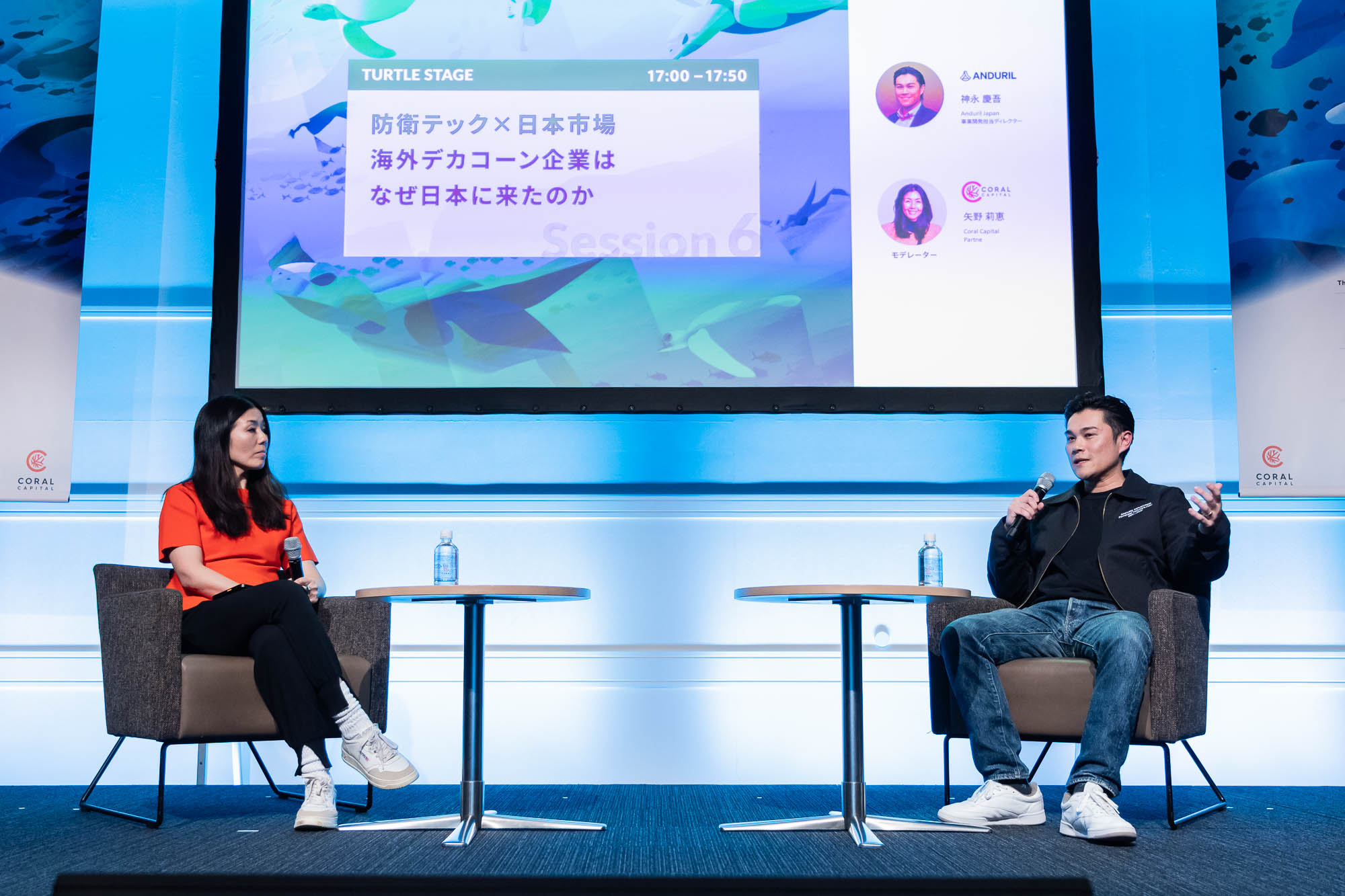
As Patrick Hollen put it, their “goal is to become a part of Japan’s industrial fabric” and to make Anduril Japan “a place where Japan’s best engineers, designers and scientists see national service as a form of innovation.”
Helping to Change Japan
Coral was one of the first firms in Japan to discuss defense investment seriously. We have backed Japan’s earliest dual-use startups, including Oceanic Constellations, which is building swarm-controlled unmanned surface vessels with NYK Group’s Keihin Dock, and Ookuma Diamond Device, which is producing 500°C-resistant diamond semiconductors for satellite communications and radar. Our portfolio company GITAI was just selected as a prime contractor for the US Space Force’s Space-Based Interceptor program, alongside SpaceX, Anduril, Lockheed Martin, and Northrop Grumman.
Clearly, Japan has a lot going for it. But the local industry has too few new players. The key question is this: if Japan has played such an important role in building Anduril, why didn’t an Anduril come out of Japan?
The talent is here. The industrial base is here. The precision manufacturing culture is here. Yet the company that turned that capability into the most valuable defense startup in history was founded in Costa Mesa, not Kawasaki.
The shortest answer is that this is not a talent problem or an industrial base problem. It is a mindset problem.
America’s greatest strength is irrational optimism. It is what pulls the world’s best talent to America, on the conviction that anything is possible. That’s how they build the seemingly impossible. Japan’s greatest weakness is irrational pessimism. For three decades the Lost Decades narrative became self-reinforcing. Founders did not think big enough, so global investors did not look, so no global companies emerged, so policymakers did not prioritize, so founders did not think big enough. The loop holds itself in place.
Resetting this mindset requires role models and proof. People need to see that someone like them, in their country, in their language, working with their suppliers, can build something extraordinary.
The Anduril Japan Alumni
Our hope is that Anduril coming to Japan has long-term second order effects.
If Anduril builds here at scale and hires the best Japanese engineers, those engineers will learn the Anduril way of doing things. They will see how a company can invest its own R&D capital before a single government contract is signed, how a software-defined architecture can be wrapped around hardware, how Silicon Valley speed can be reconciled with the unforgiving reliability standards of military systems. They will see that all of this is possible. And some portion of them, eventually, will leave to start their own companies. That is how ecosystems get built.
Call it the Anduril Japan Alumni. Not necessarily in defense but also aerospace, energy, robotics, autonomous vehicles, industrial software, any of the categories where Japan’s engineering DNA already runs deep.
This is how almost every consequential industrial ecosystem in modern history has been built. Korea and China both built their modern industrial bases through this kind of cross-pollination, POSCO with Japanese reparations financing and Nippon Steel engineering, Samsung Electronics through joint ventures with Sanyo and NEC.
Japan’s own industrial prowess began the same way. W. Edwards Deming was American. He went to Japan in 1950 at the invitation of JUSE to teach statistical process control to a country still rebuilding from the war. Japanese manufacturers took his ideas, combined them with their own tacit knowledge (“anmokuchi” in Japanese), and built the Toyota Production System and the kaizen culture that the rest of the world has been trying to import ever since. What emerged was distinctly Japanese; however it was based on foreign ideas. Cross-pollination was the unlock.
This is what Anduril building in Japan can do. Knowledge transfers through proximity and hiring, and most importantly, inspiration.
We need a company of Anduril’s caliber in Japan, and we need Japanese engineers inside it. This is how we help Japan build a stronger local ecosystem.
Why Defense, Why Now
Investing in defense in a country that chose pacifism after the Second World War is not something we take lightly as a Japanese firm. Article 9 is not a footnote. Eighty years of constitutional restraint, careful diplomacy, and a refusal to project military power is something Japan should be proud of, and something we at Coral think hard about before we touch this category.
These traditions did not emerge naturally out of nowhere. They were built over decades of cooperation between Japan and the United States, as both countries brought their respective strengths and responsibilities to support peace, stability, and prosperity in the Indo-Pacific region.
The world under that arrangement is changing. Northeast Asia in particular sits at the intersection of three nuclear powers and one of the most dangerous unresolved territorial disputes in the world. The nature of combat is changing as artificial intelligence reshapes both the digital and physical domains. Maintaining peace will require significant capability upgrades across the alliance. Continuing to honor the spirit of Article 9, a Japan that does not start wars, now requires Japan to credibly help deter them.
War is horrible, and the cost is borne by people who never asked for it. The first objective of any responsible policy is to make sure war never starts. In this region and in this decade, that requires a credible defense posture across the alliance. Deterrence is not a concession of peace. It is what allows peace to survive in a more volatile world.
We are not a defense-focused firm and do not intend to become one. Our exposure to this category will remain small and deliberate. But where Japanese capability genuinely matters to the peace of the Indo-Pacific, and where the right partners exist on both sides of the alliance, we will show up. Some of those upgrades are coming from Japan’s existing defense primes, which have done extraordinary work. Some will come from homegrown startups like Oceanic Constellations and Ookuma Diamond Device. And some will require close collaboration with allied companies like Anduril, who bring software, scale, and a different culture of speed into the alliance.
Defense Tech Accelerates Civilian Tech
The relationship between military investment and civilian benefit has never been a one-way street.
GPS started as a US Navy program for missile and submarine navigation. The internet was a DARPA project. Jet engines, microwave ovens, radar, weather forecasting, digital imaging, and the autopilot systems in commercial aviation all trace back to military research budgets. None of these were inevitable consumer products. They became consumer products because someone insisted on solving a hard problem first, and the second-order applications followed.
The same pattern runs through Japan’s commercial history, even more sharply because of postwar export restrictions. Nikon built submarine periscopes and the 15-meter rangefinders on the battleship Yamato before it pivoted to cameras and lithography. Fujifilm produced military optical glass and aerial imaging materials before it became one of the world’s most successful pharmaceutical and materials companies. Subaru exists because the American occupation dissolved Nakajima Aircraft, the company that built nearly 26,000 wartime airframes, and the engineers reconstituted themselves as Fuji Heavy Industries. Toyota built military trucks for the Imperial Army through the war. Mitsubishi built the Zero. Yamaha’s first motorcycle engines came out of wartime machine tools that had produced fuel tanks, wing parts, and propellers for the same Mitsubishi Zero. The engineering DNA did not change. The products did.
The Shinkansen, the most globally admired symbol of postwar Japanese civilian engineering, was designed in significant part by former Nakajima and Mitsubishi aircraft engineers who had nowhere else to go after 1945.
The best case for the next twenty years is that defense investment helps maintain peace, and that society inherits a generation of frontier technologies that, like GPS and the internet before them, end up doing far more for ordinary life than for warfare.
Building with Japan
Anduril is one of the most important companies for Japan’s future in the last decade, because of what it is choosing to build here, and the kind of cross-pollination that begins the moment a company of this caliber decides to hire Japanese engineers, work with Japanese suppliers, and put manufacturing capacity on Japanese soil.
Welcome to Japan, Anduril. We will spend the coming years helping you deepen the work across Japanese talent, capital, government, and industry. We will also be looking for the Japanese founders who, ten years from now, start the companies that come out of this moment.
The US-Japan alliance has held the Indo-Pacific in place for eighty years. The next phase of it will be industrial. We are honored to be working on this cause.
For questions about this investment or about Coral Capital’s broader work in Japan deep tech, please contact [email protected] or [email protected].