Accel, one of Silicon Valley’s most storied venture firms, has a concept it calls the “Prepared Mind,” borrowed from Pasteur’s line that chance favors the prepared mind.
At Coral, while we believe that the most valuable hints about the future come from the people actually building companies, we also believe in continuously learning so that we can spot greatness when we see it.
So in the spirit of developing a Prepared Mind, we started the Professorship Series. Each of us takes a space that matters to Japan, goes deep, and comes back to make everyone else smarter and to sharpen our sense of where the opportunities to invest might be.
My subject matter was Energy. Considering the hours put into it, it felt mottainai to let all of that die inside a deck. Here are a few of the charts that stuck with me, organized around the one number I keep coming back to: 16.4%. It is Japan’s energy self-sufficiency ratio in 2024, and it sits among the very lowest in the OECD.
Self-Sufficiency is lens for everything
Most energy conversations start with decarbonization. I think you should start with the gap. Japan imports almost everything that powers it, and even under the government’s aggressive 2040 plan, self-sufficiency only claws back to somewhere between 30 and 40%. That is still far short of the roughly 70% OECD average.
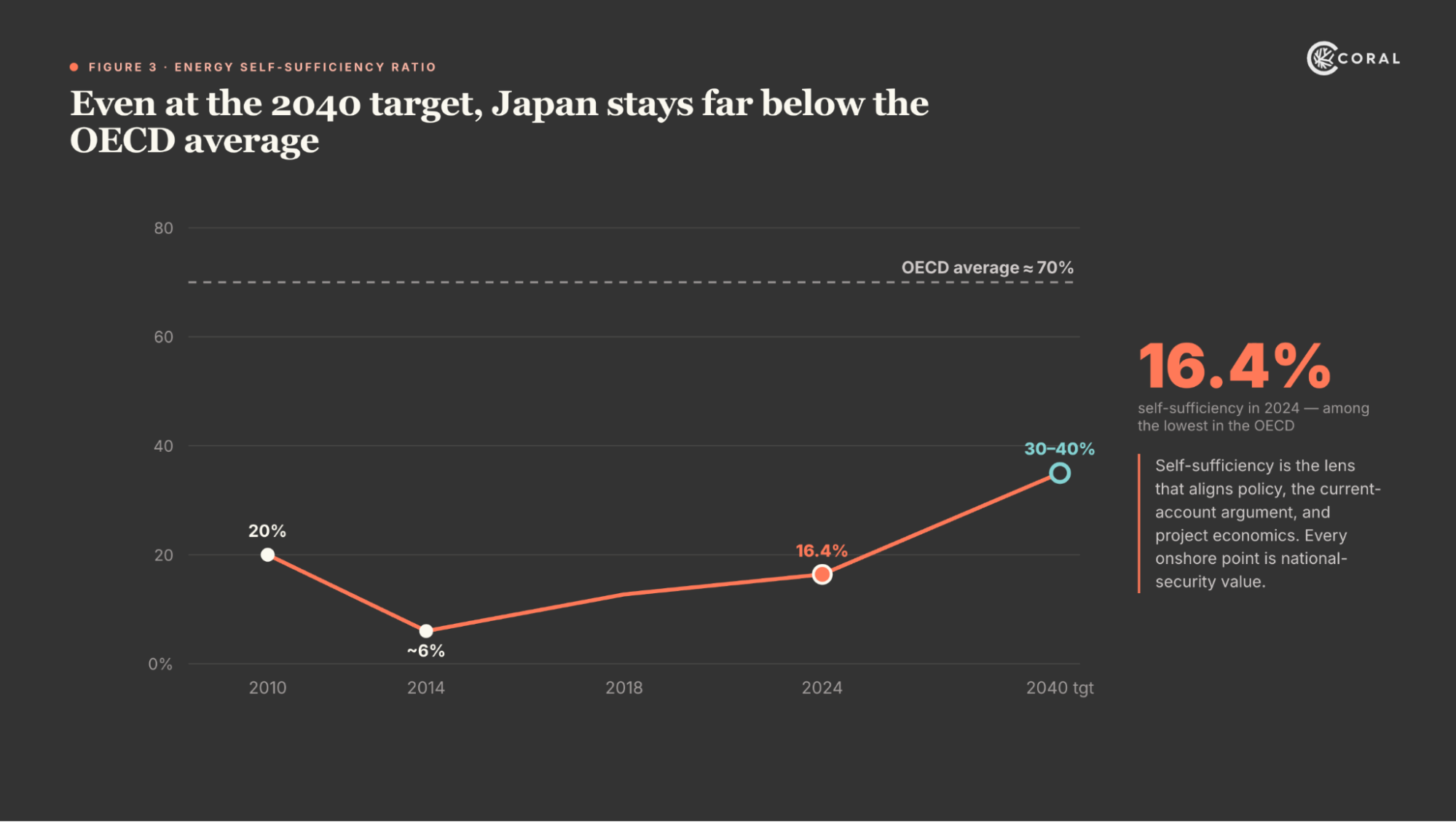
This is the lens I now read everything else through. Every kilowatt-hour Japan generates onshore is a matter of national security, not just cost or carbon. Self-sufficiency ties together the country’s energy policy, its trade balance, and the economics of any single project. So the question I ask of every technology is: does this actually make Japan more self-sufficient, or does it just swap one import for another?
It could get worse
The uncomfortable part is that the gap may get wider. After two decades of falling electricity demand, driven by efficiency gains and a shrinking population, Japan’s consumption is turning back up. The driver is AI. Data-center power demand is on track to roughly triple by 2034, and data centers alone account for about 60% of all projected demand growth over the decade.
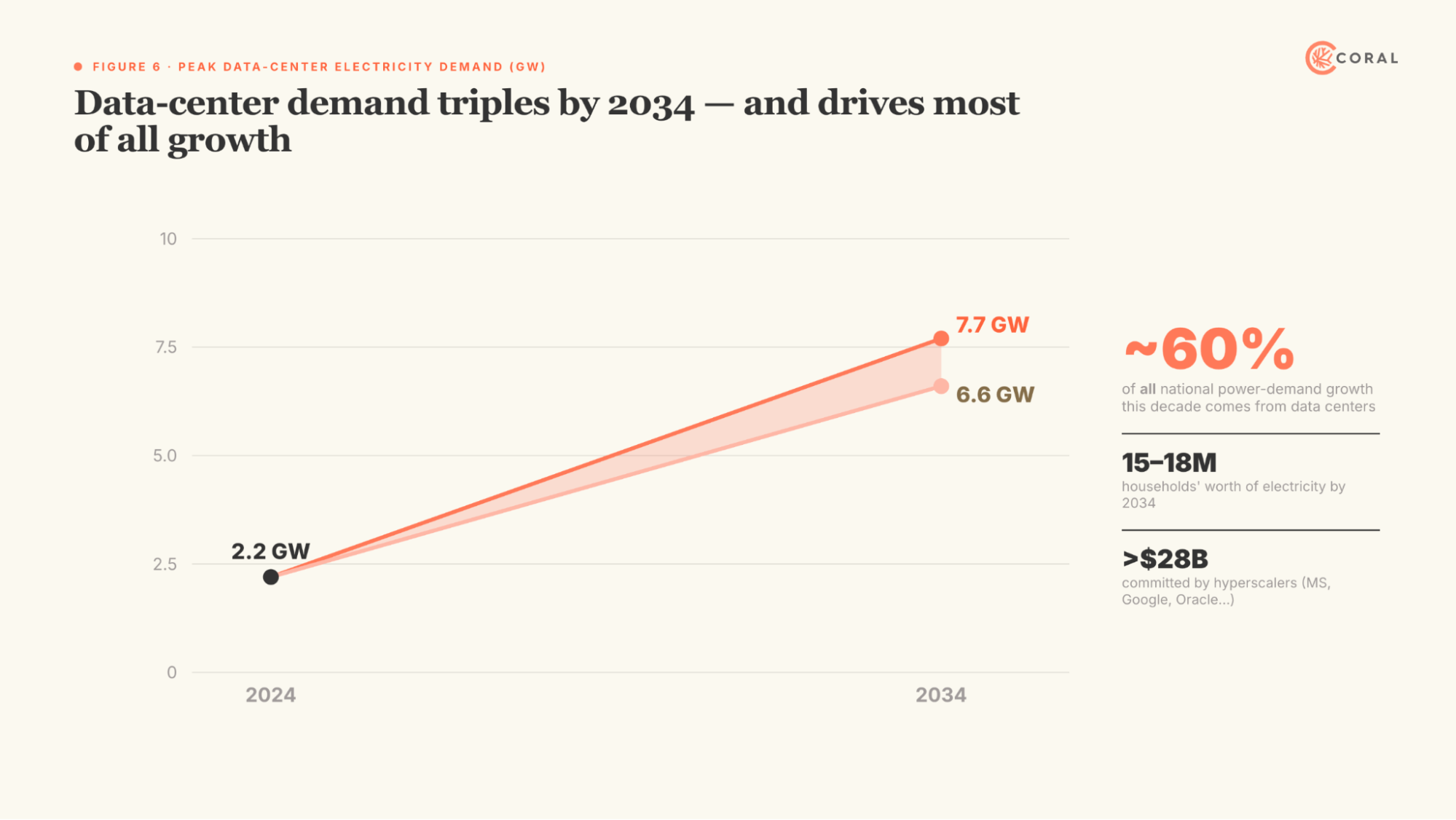
So Japan has to rebuild its entire energy system and grow it, inside a carbon-neutral mandate, from the weakest supply position in the developed world. That is a lot to take on at once, but there’s hope.
Sun, with strings
Inside the renewables mix, this is overwhelmingly a solar story. Solar goes from 0.3% of national generation in 2010 to a planned 26% by 2040, a 87x climb that is the single largest shift in the whole transition.
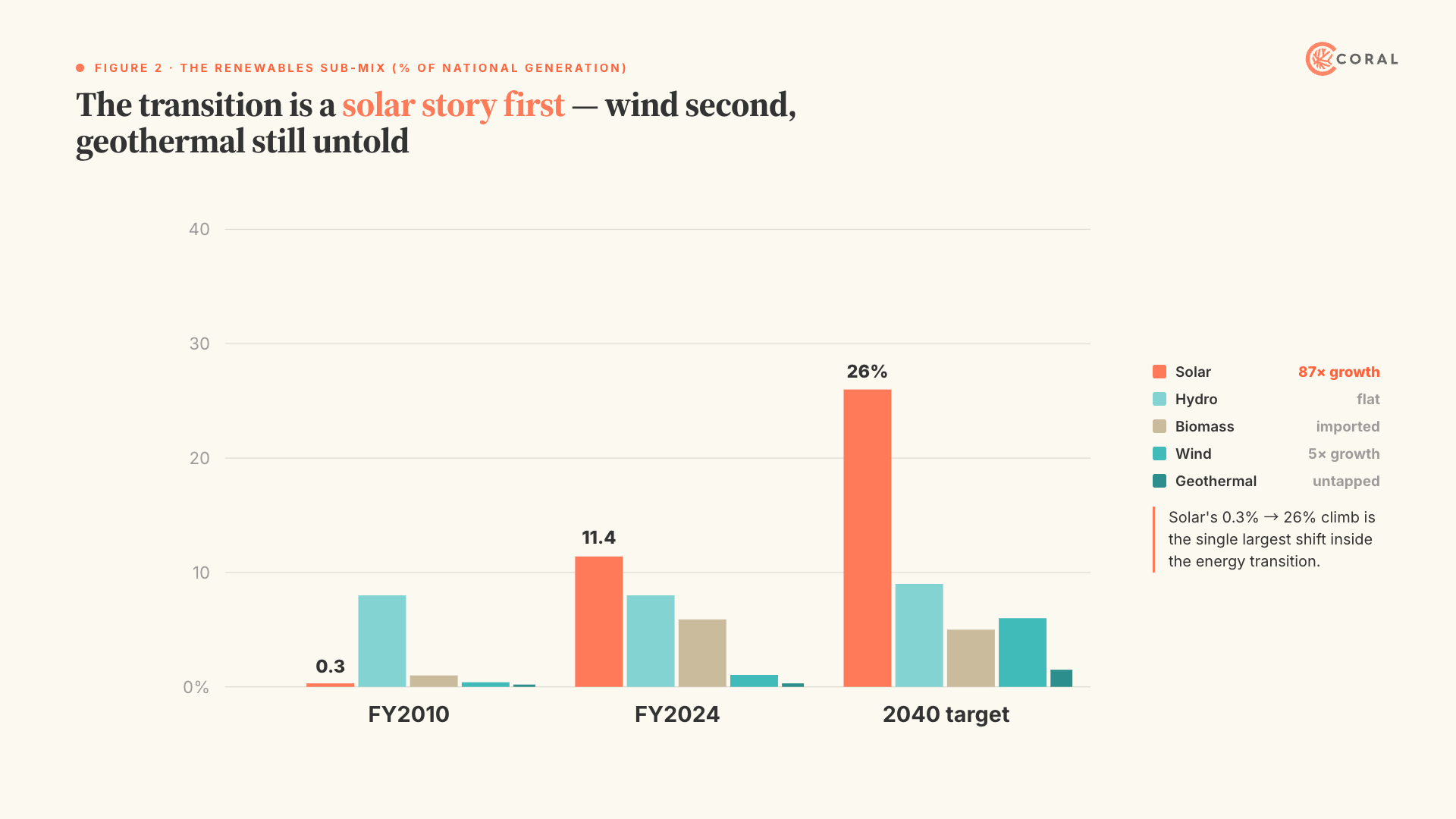
Now apply the lens. Roughly 80% of the world’s solar modules are Chinese. To be fair, a silicon panel is not oil. You buy it once and it generates for twenty years, so it beats a barrel you burn and have to rebuy the next day. But the dependency does not disappear. It moves upstream and stretches out over time, because every replacement cycle, capacity expansion, and spare part still routes back through a single country. The energy transition is freedom from the petrostates, but the solar supply chain risks trading Hormuz oil and Russian gas for Xinjiang silicon. After the 2026 Strait of Hormuz scare, with something like 80% of Japan’s crude passing through that one waterway, the cost of concentrating a supply chain doesn’t seem like good planning.
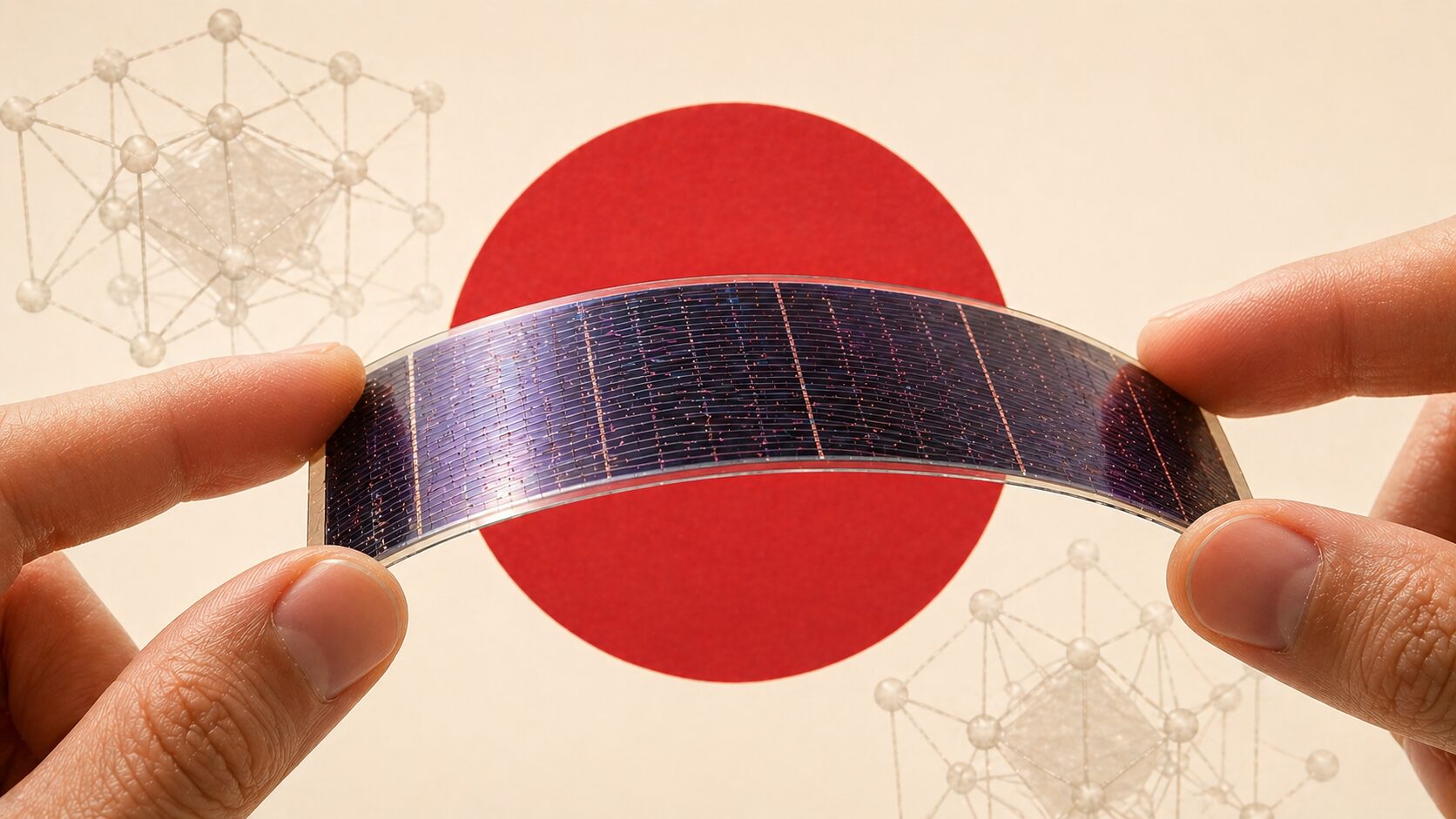
This is why I got interested in perovskite, which I wrote about separately in Why Japan, Not China, Will Win the Next Solar War. The short version: perovskite cells run on iodine, and Japan sits on about 80% of the world’s known iodine reserves. Japan has an extraordinary advantage to compete in the next solar war.
Back to the atom
If self-sufficiency is the metric to watch, nuclear is where Japan can significantly move the number.
Before Fukushima, nuclear power supplied roughly 30% of the country’s electricity and underwrote the highest energy self-sufficiency Japan has reached in its modern history. The 2011 shutdown reversed that almost overnight, taking the country from its most secure position to one of its least. The restart now underway is less a new bet than an attempt to recover ground Japan once held.
The restart is underway. Fifteen reactors have cleared the post-Fukushima regulatory gauntlet and are back online, giving Japan more than 31 gigawatts of operable zero-carbon capacity, with another ten in the approval queue. The 2040 plan puts nuclear back at 20% of the mix. Reactor-grade steel and reactor IP are largely domestic, and uranium is stockpilable in a way LNG is not.
That said, restarting reactors only solves half the security equation. The other half is fuel, and here Japan is once again dependent on a narrow set of foreign hands. It imports virtually all of its enriched uranium and cut Russian supply entirely after the invasion of Ukraine. The global picture is stark: the United States once ran about 86% of world enrichment capacity, then let its last American plant close in 2013, leaving Russia with close to half of global supply and China scaling fast. The fuel meant to deliver energy sovereignty flows through a chain Japan does not control, the same vulnerability that shaped the crises of 1941 and the 1970s.
That is the gap General Matter is built to close, and it is why we backed them. Founder Scott Nolan is ex-SpaceX and spent over a decade at Founders Fund before starting the company in 2023 to rebuild American enrichment on the exact Kentucky site where the US last made this fuel. What makes it matter for Japan is the $2.4B letter of interest from the US Export-Import Bank, unveiled in Tokyo, to finance Japanese utilities buying American enriched uranium over the next decade. Nuclear fuel is becoming a financeable, allied supply chain, and the US-Japan energy alliance is hardening around it. Peter Thiel joined the board, and he almost never joins boards. I got into all of this with Scott over sushi on our Omakase podcast.
Building a sun
The long game is fusion, and Japan’s position there is not an accident of policy. It is downstream of the same industrial base that defined its fission era. A fusion plant is, in large part, a precision-manufacturing problem, and Japan already makes most of the hard parts: Furukawa in high-temperature superconducting magnet wire, Mitsubishi Heavy in vacuum vessels and reactor-grade magnets, Toshiba in superconducting coils and heavy electrical systems. Japan can move because the components it needs are right here at home.
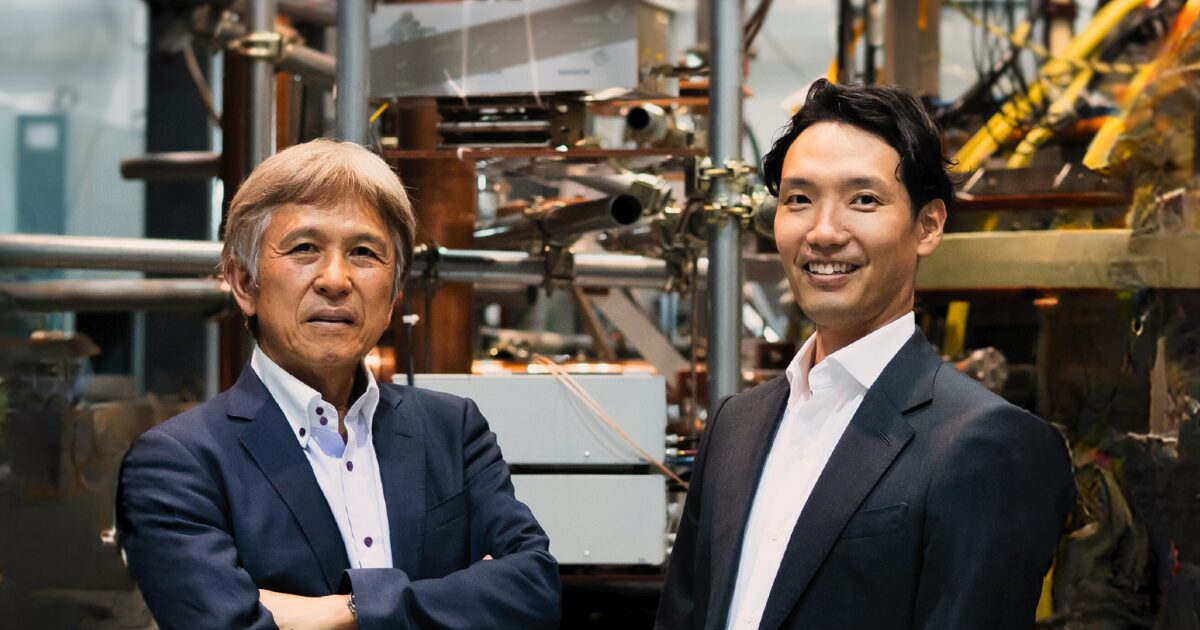
Our portfolio company Kyoto Fusioneering is leading the charge. Rather than race to build a reactor and bet on one physics pathway, it sells the hardware every reactor design will need, whoever wins. Its gyrotrons for plasma heating are as good as any in the field and already installed at Tokamak Energy, UKAEA, and the US Department of Energy’s DIII-D, and it is working on the breeding blanket, the hardest unsolved problem in commercial fusion. The result is a company that earns money today by selling to everyone, while keeping a stake in whichever design eventually works.
Follow the Self-Sufficiency Number
Run every option Japan can put on its grid through the tradeoff matrix, scoring cost, speed, safety, and self-sufficiency, and the technologies that score highest on self-sufficiency turn out to be the ones with the most promising businesses underneath them: nuclear restarts and the fuel chain behind them, perovskite, geothermal, batteries, and fusion components.
What makes a technology self-sufficient, whether a scarce domestic resource like iodine, homegrown IP, or a supply chain advantage, is usually the same thing that gives a company pricing power and a policy tailwind behind it. The options that fail the test, new coal, oil, imported biomass, ammonia co-firing, lock Japan into foreign fuel or foreign equipment, and they are the weaker businesses for the same reason.
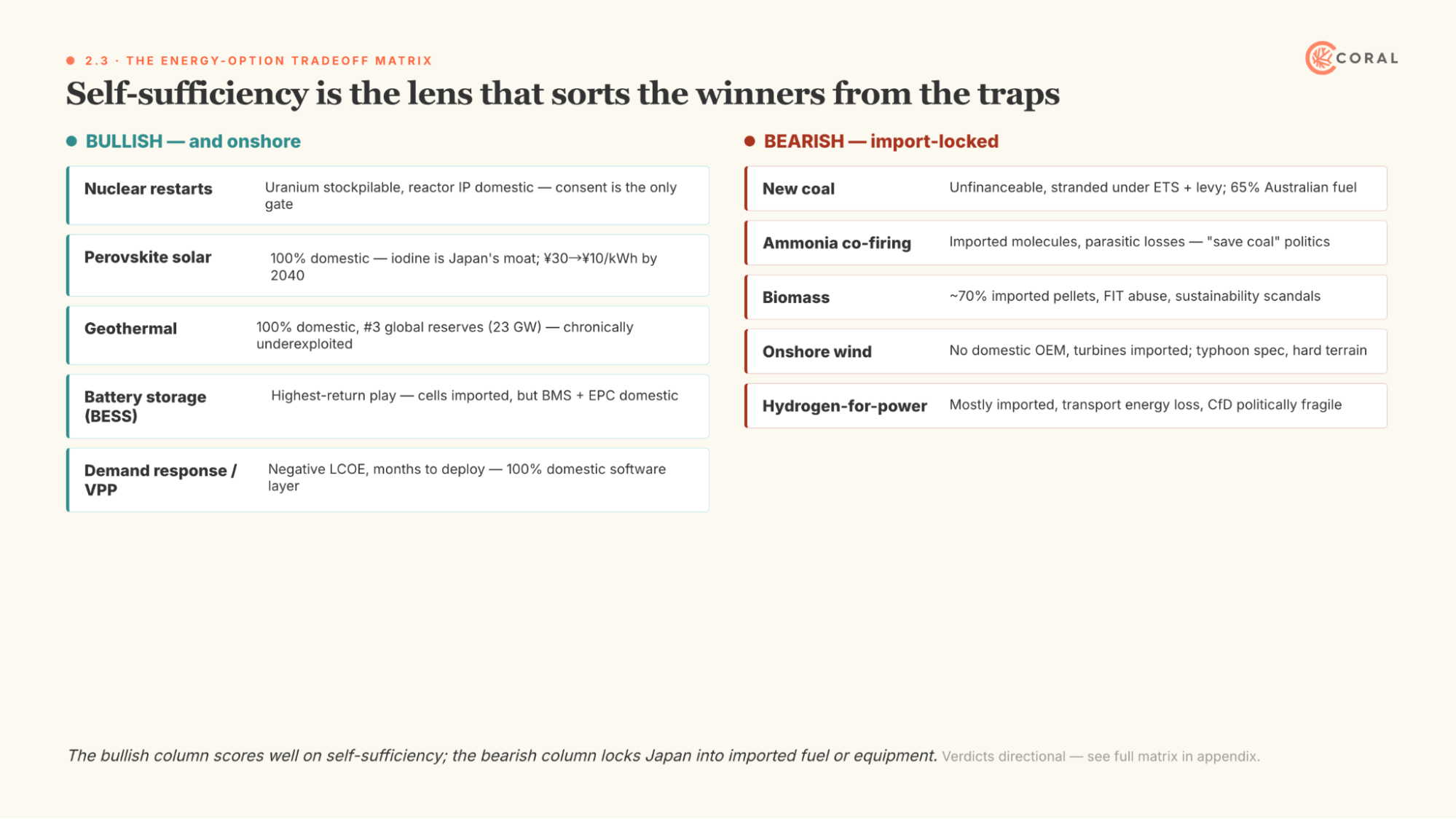
It helps that the capital is already committed, roughly ¥150 trillion (~$925b) of public and private money over the next decade.
Self-sufficiency is the goal. In a country that imports the overwhelming majority of its energy, the companies worth backing are the ones that shrink that number. Everything else is just moving the dependency around.