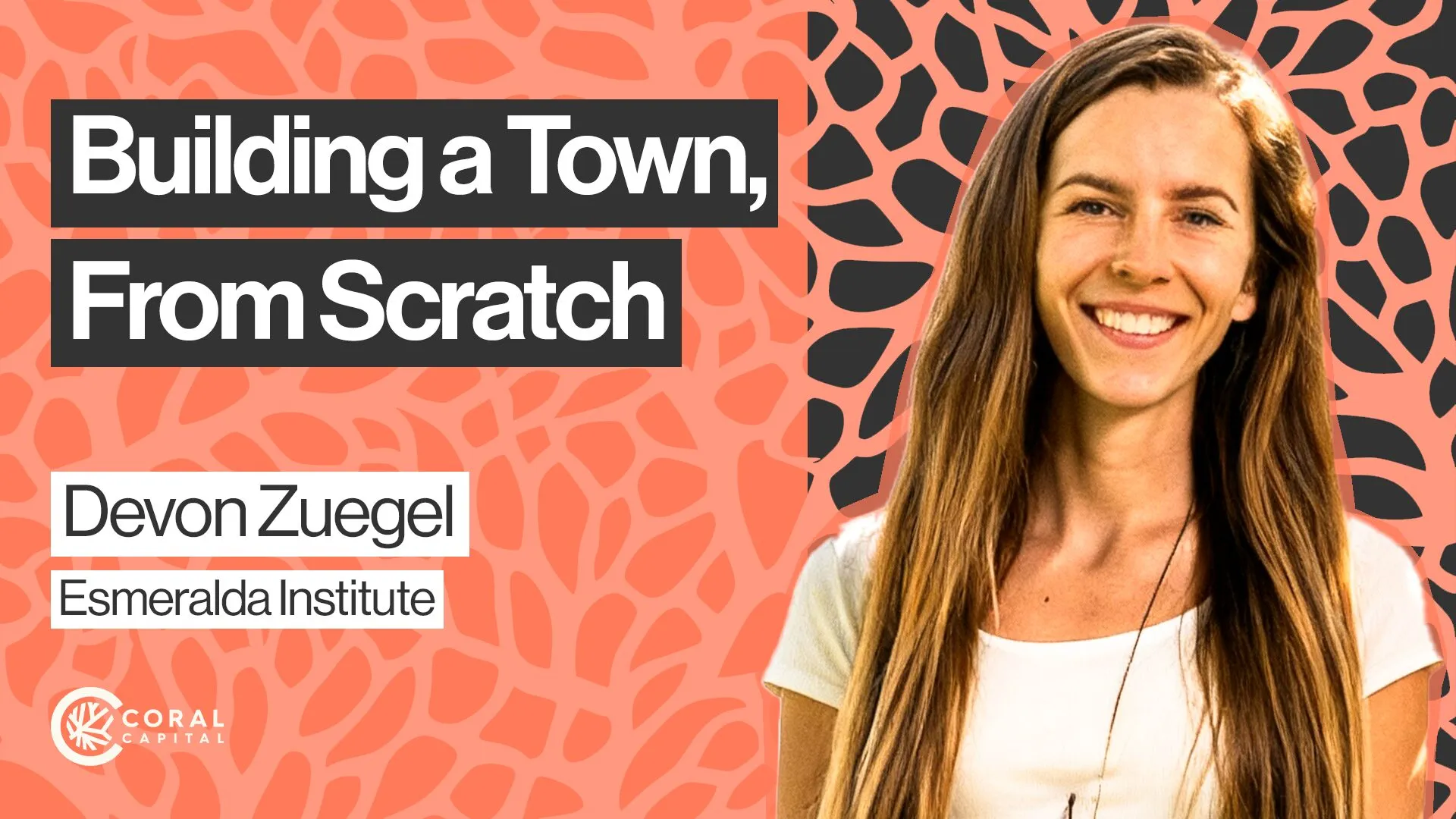
Recently on the Coral Capital Podcast, we sat down with Devon Zuegel, who built open-source projects like GitHub Sponsors, and is now bringing her ideas to life through a new town called Esmeralda.
A Town Born from Childhood Summers
Devon spent every summer of her childhood in Chautauqua, a small town in western New York where her grandmother lived. The slow rhythms, unified community, and gatherings in Chautauqua stayed with her long after those childhood years.
This inspired her to create a modern-day Chautauqua: Esmeralda, a village about 90 minutes north of San Francisco.
What’s fascinating is how she frames it in terms of “hardware and software.” The hardware is walkable streets and front porches that people actually inhabit, the small, thoughtful details that quietly shape everyday life, while the software is a culture of lectures, workshops, and lifelong learning.
Her aim is to capture that same spirit of curiosity, connection, and intergenerational engagement in California’s wine country.
Devon’s Leap from Code to Community Design
In the first half of her career as a software engineer, living in San Francisco exposed her to a stark contrast: wealth and opportunity alongside streets filled with people without homes.
That gap drew her into housing and land-use policy, where she realized regulations, not resources, were often the biggest barrier.
Rather than just critique, she chose to build solutions herself.
While she still codes, including Esmeralda’s website, her main focus is turning California’s complex rules into actionable change, creating real communities designed with the same care and intentionality she once brought to software.
What Is Village Urbanism?
Village urbanism, as Devon calls it, is a compact town where everything you need is just a short walk away, and open countryside is never far.
She draws inspiration from Mediterranean and Japanese villages, imagining a place where walkability, community, and open space naturally coexist, a balance you rarely see in U.S. suburbs or cities.
What Devon is doing with this concept is tackling the coordination problem cars created, where the desire for private space fragments communities, while still keeping the neighborhood vibrant and connected.
The Mechanics of Esmeralda
Esmeralda sits on about 300 acres, roughly a third of Golden Gate Park. And honestly, that really helps you picture it, it’s big enough to feel like a proper village, but still cozy and walkable.
Devon envisions starting with about 1,600 residents, creating a close-knit community that can expand naturally.
The location is carefully chosen: near towns for essentials but far enough to create something entirely new. Sonoma County Airport is 20 minutes away, and SFO and Oakland are about an hour and a half. I love how Devon pairs big ambitions with practicality to make it actually work for people.
Designing for Every Generation
Devon’s vision for Esmeralda is a multi-generational community of curious, collaborative makers and learners, where the people bring Esmeralda to life even before the first house is built.
Sonoma County, like much of Northern California, has an aging population, and she sees that as an opportunity to help the older population play an active role.
Edge Esmeralda, the pilot event, has been a great testing ground.
Devon shared how small design choices make a big difference, placing kids’ rooms near but not next to lecture spaces, seeing initially skeptical older participants become some of the most engaged, and testing what truly fosters intergenerational connection before building anything.
To hear more about Devon’s approach to planning a whole town, from detailed site analysis to financial modeling and navigating California’s tricky politics, tune in to our full conversation on YouTube, Apple Podcasts, or Spotify.